
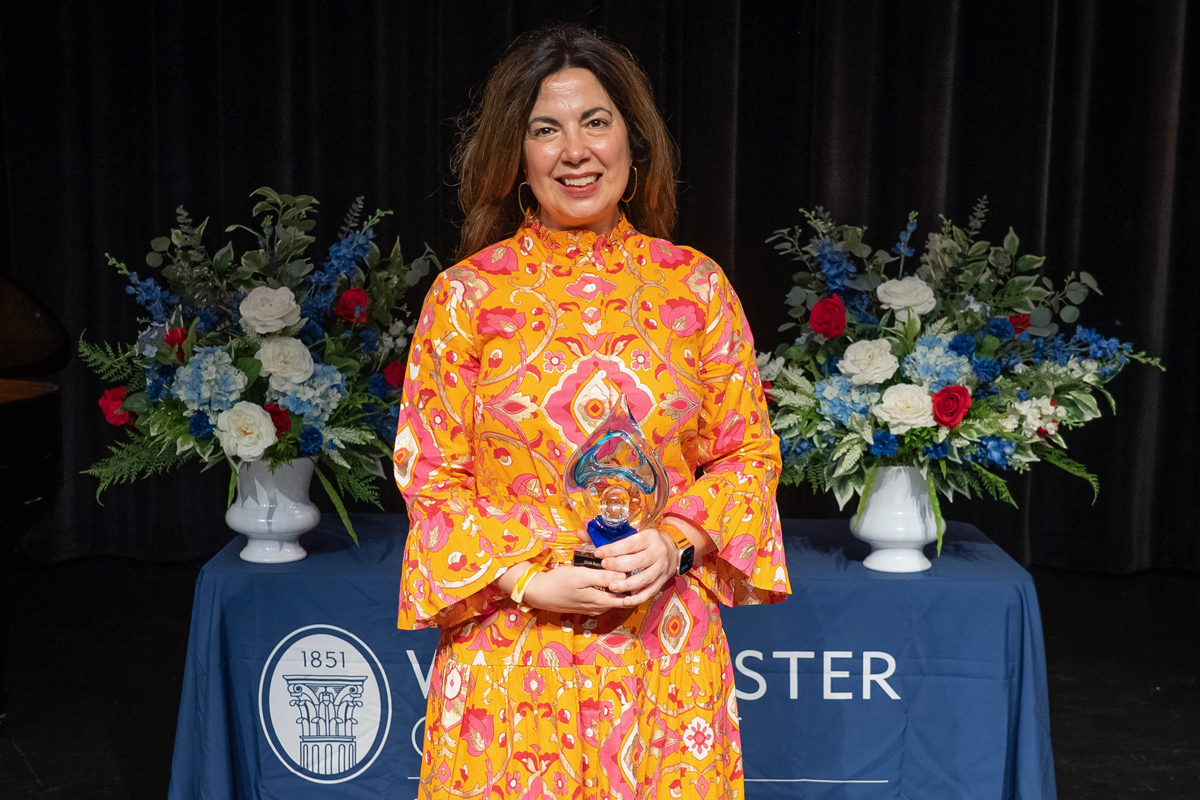

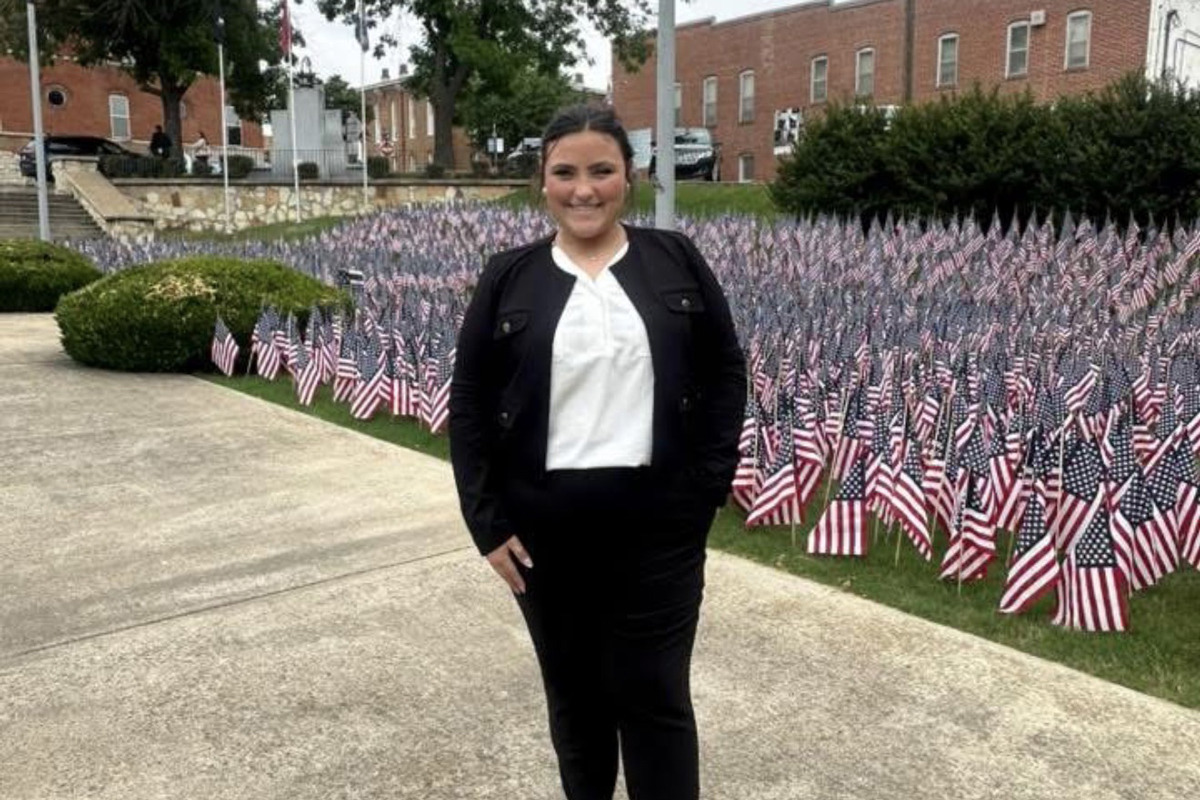
Dr. Natasia Sexton is pictured above with the Remley Award she received during the 2026 Alumni Awards Convocation. This article is the fifth in a series found on the Notes From the Nest blog on why liberal arts degrees are so desperately needed in society today.
The subject under discussion on a random Wednesday in Dr. Natasia Sexton’s 12 p.m. choral ensemble class is cheerful willingness performed with sincerity. The Churchill Singers director draws out the term “Ah-LAA-yack-ruh-tea!” in a strong, Southern drawl as she scrawls the noun “alacrity” on the music classroom’s whiteboard.
Sexton then suggests how the term is conveyed in facial expression, posture and attitude, applying the non-musical lesson not only to her class but to life in general. Then an open discussion on the term ensues.
The Transformational Role of a Liberal Arts Education
“I’ve thought a lot about my role at Westminster College and what can be transformational for our students,” Sexton reflects, explaining that music is not a major at the College but is part of the Aesthetics Theme within the corresponding Power of Creativity cluster of courses that all Westminster students are required to take. Six themes and corresponding clusters undergird the College’s core curriculum.
Sexton, who serves as chair of Westminster’s Division of Humanities, explains that one of the priorities at a liberal arts college is holistic development. In her music classes, transformation results in poised confidence in front of large groups of people.
This seemingly minor lesson taking place in one class on one day of a Westminster education easily escapes glossy brochures from admissions offices and lengthy articles detailing the tug of war currently taking place between vocational schools, universities and small, private colleges.
Transcending the Current Tug of War in Higher Education
The lesson is, frankly, difficult to sum up tidily in a complex higher education environment, where anxiety runs high among parents, prospective students and administrators focused on metrics and money. Online publications that prey on insecurities through click-bait articles only add fuel to the fire.
The current debate goes something like this: Should colleges and universities be more like vocational schools, teaching job skills and dropping what some view as lofty ambitions — virtually all of the humanities as well as soft skills like communication, adaptability, problem-solving and teamwork? Will doing so hold value long-term? Will AI take over skilled employment, rendering the youth of America jobless? Will liberal arts colleges experience a new Renaissance as skill-based training is wiped out by AI?
Westminster has, since 1851, weathered higher-education debates and maintained that a liberal arts education produces accomplished leaders who out-earn their peers in the long run. Plans for celebrating our strong 175-year educational tradition during this anniversary year are currently underway. And with good reason. Westminster is, after all, one of the oldest colleges in Missouri and has long been celebrated for its academic rigor.
STEM Majors and the Liberal Arts
For now, the state of higher education is far from the minds of Sexton’s students, who are deeply and happily engaged in their studies. Three in particular singled out the associate professor of music and College vice marshal for recognition during their induction on May 9 into the Alpha Chi National Honor Society.
Of those students, two are STEM majors: Annabelle Bryan and Adam Rosh.
 Bryan is a rising junior from St. Charles, Missouri, who is double-majoring in mathematical data science and political science. As a result of Westminster’s small environment, she is a member of numerous campus organizations, including the Student Government Association, Panhellenic Council, Student Ambassadors and the Blue Blazers Investment Committee.
“When I go to Churchill Singers, I get to disengage from the math side of my brain. Then, when I leave choir and go to my other classes, I have increased concentration and vigor because I was able to work on something completely different,” Bryan says. “This makes my holistic college experience more enjoyable.”
 Rosh, a rising junior from Fenton, Missouri, is a Blue Jays volleyball player, serves on the Campus Activities Board and is a member of the Phi Delta Theta fraternity. He majors in biology with a minor in public health.
“Dr. Sexton has taught me that being reliable and engaged with people in my community will help me continue to grow as a student, an athlete and a person,” he reflects.
Incidentally, community involvement is woven into the Westminster curriculum, and classroom emphasis on the subject’s importance is one way faculty such as Sexton broaden students’ outlook on the world.
Cross-Disciplinary, Independent Undergraduate Research and the Liberal Arts
 Not to be forgotten is the third student who formally recognized Sexton during this spring’s Alpha Chi induction ceremony: Natalie Benton, Class of 2026, from St. Peters, Missouri. Benton completed an upper-level, independent study course, Music of Resistance, with Sexton during her junior year.
Such coursework exemplifies another hidden aspect of a Westminster liberal arts education: cross-disciplinary, independent undergraduate research overseen closely by faculty.
Sexton encouraged Benton to expand upon her subject matter — the Taylor Swift-effect of activism — by adding political science conceptual framework under the direction of Dr. Kali Wright-Smith, professor of political science.
The additional layer of research conducted with Wright’s additional oversight rounded out the work and resulted in Benton presenting at the 2024 Midwest Popular Culture Association Annual Conference in Chicago.
Celebrating Student Success With Alacrity
Sexton enthusiastically traveled with Benton to the conference and celebrated her success.
This individual attention to one student’s accomplishments is typical at Westminster, where faculty willingly teach a minimum of four courses a semester, two semesters per year. By contrast, those at larger universities might only teach one course a semester while conducting research and publishing.
This summer, as she prepares for her 18th year at Westminster, Sexton is reflecting on what teaching at the College has meant to her since 2009.
“When we come to Westminster, we know we are hired to teach, and that teaching has to be effective and sometimes takes place outside of the classroom,” she says matter-of-factly.
Casual observers might say Sexton approaches her time at Westminster with a willing attitude and sincere enthusiasm.
Those in her classes might disagree. They might say Sexton actually teaches with alacrity.


Sarah Rummel Backer is the Director of Media Relations and Senior Writer at Westminster College in Fulton, Missouri. A proud Westminster graduate, Sarah has more than 20 years of experience in marketing and strategic communications in the areas of higher education, medicine, agriculture, and the private business sector.
You must be logged in to post a comment.