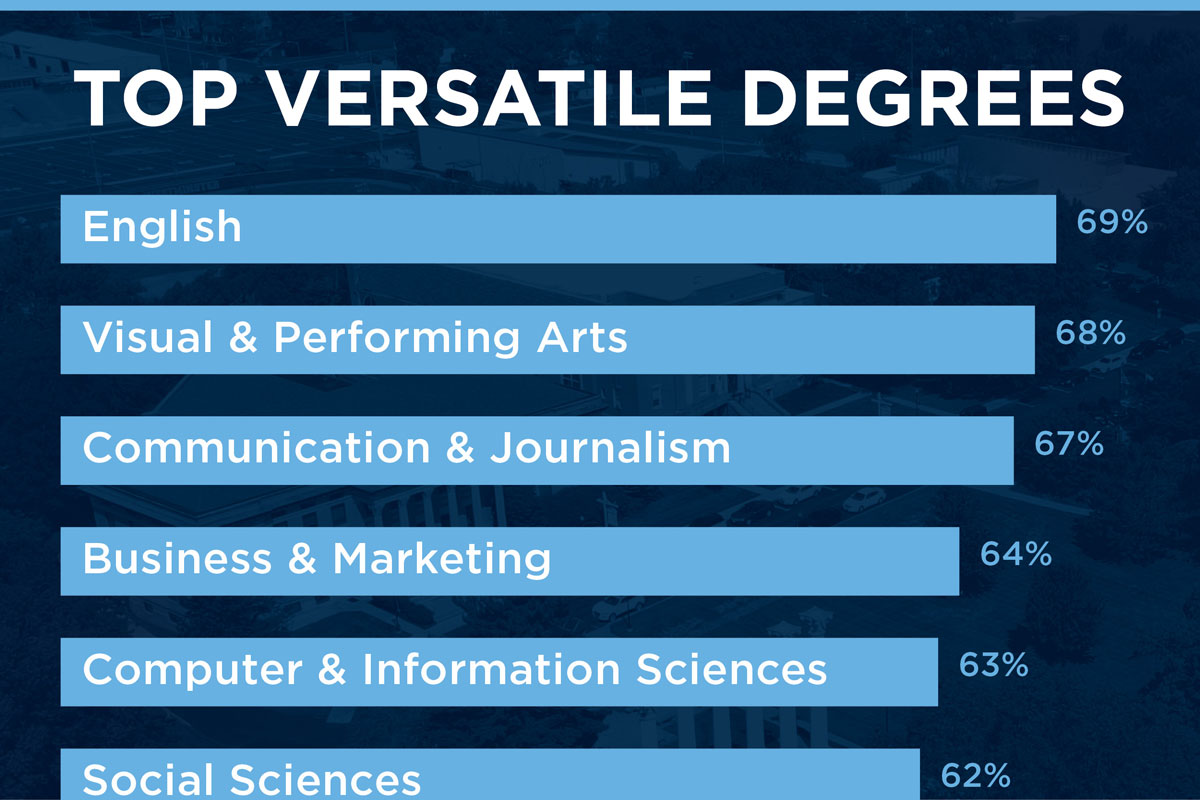


This is the third installment of a multi-part series on why liberal arts degrees are so desperately needed in society today.
Throughout high school and early college, Cameron Gehlert ’22 became known across Missouri as “The Snot Otter Kid” for leading the charge on a bill that declared the hellbender salamander, or “snot otter,” an endangered species.
In 2019, when the bill became law, Gehlert turned his energy toward academics, pursuing four majors at Westminster College in Fulton, Missouri: environmental studies, global and transnational studies, political science, and philosophy and religious studies.
Named one of two Seniors of the Year in 2022, he was accepted into American University’s highly selective public administration graduate program in Washington, D.C., earning his master’s degree with honors in 2024.
Now back in Missouri, Gehlert works as the state’s recycling coordinator: a role that challenges him daily to think critically and solve real-world problems. He credits his Westminster education with giving him the necessary soft skills — persuasive writing, public speaking and relationship-building — to have the most impact.
Those skills are the result of Westminster’s liberal arts educational format, which has nothing to do with politics. It is a broad-based education rooted in the humanities, biological/physical sciences, mathematics and social sciences.
At Westminster, students write across disciplines, analyze deeply and apply knowledge in hands-on ways, often collaborating with faculty on research that pushes them well beyond undergraduate norms. And this type of education is shown to be effective in more ways than one. Research through the Center on Education and the Workforce shows that graduates from liberal arts colleges typically earn more than publicly educated students throughout the course of a lifetime.
Yet like most Westminster graduates, Gehlert’s path to success cannot easily be summed up by job titles or income projections. A liberal arts education molds lifelong learners who embrace new ideas and have the innate ability to solve problems, which are intangible, unmeasurable qualities. Nonetheless, those characteristics may be why they are so successful in the first place.
The College recently caught up with Gehlert to learn more about how his liberal arts education continues to influence and inspire him today. Read the interview below.
How did your Westminster education foster your love of learning?
Being at Westminster really encouraged me to want to be a scholar. The professors were always passionate about their fields and I think even more passionate about fostering their students’ own interests and academic success. Within my multiple different majors, I had so many opportunities to learn a wide array of topics, which helped expand my world view and really developed my critical-thinking skills. I couldn’t possibly learn enough.
How did your liberal arts education help you in graduate school?
Grad school is a lot of writing, a ton of reading and an immense amount of criticism on your work. At Westminster, the academic rigor prepared me for taking on these challenges while also being completely familiar with constructive criticism. I noticed among some of my peers in graduate school that I was far more prepared for being able to read hundreds of pages of material a week and writing extensive papers. Without Westminster, I wouldn’t have made it through.
How is your liberal arts educational background put into use for you on the job today?
I think a liberal arts education is essential to my job. A liberal arts environment provides a well-rounded education among multiple academic disciplines, and from this, students develop skills such as critical thinking and communication. These two skills are absolutely essential in my role that requires dealing with people from all walks of life and vocations while also working to develop the program further when there are no cookie-cutter solutions.
How has your education influenced how you interact with others?
My liberal arts background has really expanded my mind to where I feel I can comfortably work with anyone from any background, because I now have a greater capacity to see situations from others’ perspectives instead of always being stuck in my own.
How do you keep your mind active now that you aren’t seeking a degree?
I definitely miss being a student, but I am still a learner and have never stopped. I am always reading and watching lectures of various topics online. Another way to help satisfy my need for learning is taking advantage of the training and leadership opportunities that the State of Missouri offers its employees. While I do enjoy dense academic subjects, especially philosophy and political science, I have also started moving toward studying more on growing personal skills such as adaptability and interpersonal communication.
What are your future plans?
At this point I am keeping my options open and trying to not be too attached to the future, especially with so many uncertainties in the world. However, I still do see myself as working in an international capacity, and I’d really hope that I am in an Asian country within the next couple of years. Whether it’s something with education or a non-governmental organization, I don’t think I will care too much. A benefit of my liberal arts education is that it cultivated many of my interests to where I think I could find fulfillment in many different occupations.


Sarah Rummel Backer is the Director of Media Relations and Senior Writer at Westminster College in Fulton, Missouri. A proud Westminster graduate, Sarah has more than 20 years of experience in marketing and strategic communications in the areas of higher education, medicine, agriculture, and the private business sector.