


Members of the Natural Resources Committee for the U.S. House of Representatives looked on with sincere interest when Missouri Congressman Bob Onder and Timothy Riley of America’s National Churchill Museum (ANCM) testified before them on July 16 in Washington, D.C.
Onder and Riley, ANCM’s Sandra L. and Monroe E. Trout Curator and Director, explained with eloquence during the Federal Lands Legislative Hearing why ANCM should be designated a National Historic Landmark.

Testimony by Missouri Congressman Bob Onder
Aware of ANCM’s historic significance both nationally and internationally, Onder described why he created H.R. 1945: America’s National Churchill Museum National Historic Landmark Act. He deftly stated that the designation is “both long overdue and deeply deserved.”
Onder added, “I urge the committee to support this bill and ensure that America’s National Churchill Museum receives the recognition it so clearly merits as a National Historic Landmark.”
If H.R. 1945 passes, ANCM would be added to a list of approximately 2,600 National Historic Landmarks: places deemed significant to the history and heritage of the United States.
Testimony by ANCM’s Timothy Riley
In a succinct five-minute testimony, Riley outlined ANCM’s remarkable story and historic significance.
In the 1960s, Westminster College’s President R.L.D. Davidson envisioned what Winston Churchill later referred to as “an imaginative concept.” He made the audacious decision to ship a partially destroyed ancient church designed by Royal Architect Sir Christopher Wren from London to Fulton, Missouri.
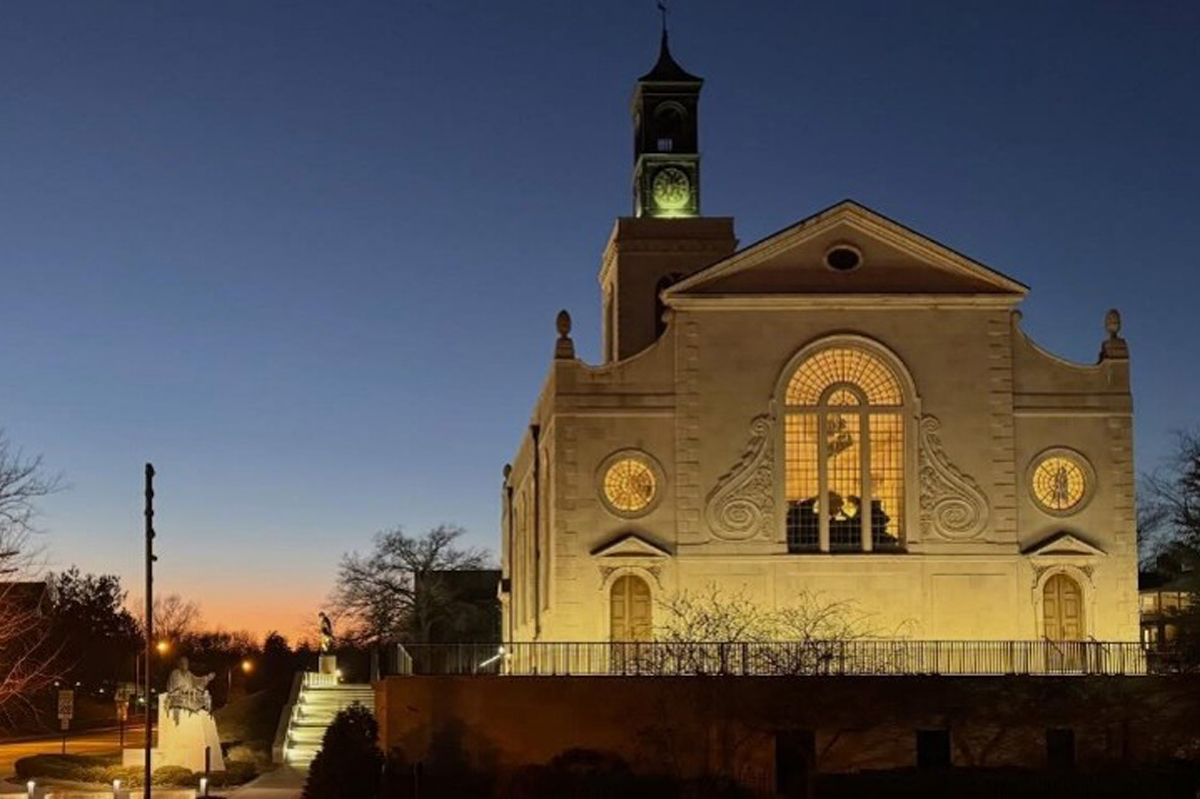
The structure ― rebuilt piece by piece at Westminster College ― today stands as a memorial to Winston Churchill’s “Iron Curtain” speech delivered on campus in 1946.

ANCM’s extraordinary history
Riley explained ANCM’s extraordinary history. St. Mary the Virgin, Aldermanbury, dating back to at least the 1100s, has withstood the test of time after being mostly destroyed during the Great Fire of London in the 17th century and famously rebuilt by Wren. Then, the fated yet resilient structure was bombed during the Blitz of Word War II.
Like many stone or brick buildings in London, St. Mary’s laid in partial ruins for decades.
The 7,000 stones that compose ANCM in what the Times of London once referred to as “the biggest jigsaw puzzle in the history of architecture” now stand together as a recognizable symbol of a monumental speech that aptly foreshadowed the Cold War.


A worker sorts through the 7,000 stones of St. Mary the Virgin, Aldermanbury, shipped from London in the mid-1960s (left). The structure today is known worldwide as America’s National Churchill Museum (center), which commemorates the life and times of Winston Churchill. The red robe, purple hood and black hat pictured here (right) are replicas of the academic regalia that Churchill wore on Westminster’s campus when he delivered his “Iron Curtain” speech on March 5, 1946. The display is one of many in ANCM’s extensive collection, which houses other items belonging to Churchill, including a number his original oil paintings, as well as displays relating to World War II and the Cold War.
Today, the unique structure dedicated in 1969 is the only museum of its kind dedicated to the life and times of Winston Churchill. Not only that, the building is an architectural marvel.
“Ladies and gentleman, the building we speak about today has been a landmark in some form or fashion on our shores, across the Atlantic, for almost 900 years,” Riley said with emphasis. “Today we ask that it be designated a United States National Landmark.”
He then stressed that Westminster College and ANCM are committed to preserving the building’s rich history for new generations to come.

A symbol of steadfastness in the face of adversity
At the end of his presentation, Riley emphasized that the Museum stands as a symbol of steadfastness in the face of adversity.
In conclusion, Riley said, “I think it appropriate to let Churchill have the final word today. These words from 1943 seem fitting: He said, ‘We shape our buildings, and afterwards, our buildings shape us.’ At America’s National Churchill Museum at Westminster College, we have a landmark that continues to shape us in a most meaningful manner.
For more information on ANCM’s congressional hearing, please contact Tim.Riley@WCMO.edu.


Sarah Rummel Backer is the Director of Media Relations and Senior Writer at Westminster College in Fulton, Missouri. A proud Westminster graduate, Sarah has more than 20 years of experience in marketing and strategic communications in the areas of higher education, medicine, agriculture, and the private business sector.

You must be logged in to post a comment.